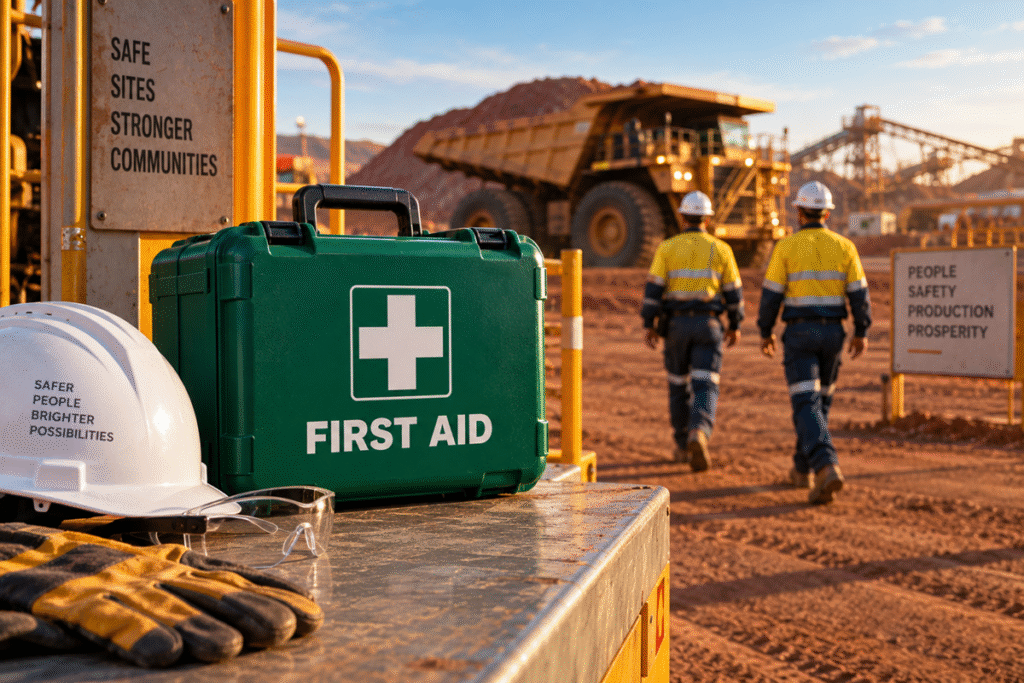
A standard workplace first aid kit is designed for office cuts and minor sprains. A mine site is not an office. Crush injuries from heavy plant, burns from welding equipment, eye trauma from flying debris, heat exhaustion in remote locations kilometres from the nearest hospital — these are the realistic scenarios that play out on Australian mining operations every shift.
The difference between a compliant, purpose-built first aid kit for the mining industry and a generic kit from a hardware store could be the difference between a worker surviving a serious incident and not.
The stakes are real. According to research published by Edith Cowan University, a single six-month period in the Australian mining sector recorded 837 reported injuries, including three fatalities. Sprains and strains were the most common (69%), followed by fractures (10%), lacerations (6%), and crush injuries (5%). Each of those injury types demands specific equipment that most off-the-shelf kits simply do not carry.
This guide covers what a mining first aid kit must contain, what Australian regulations require, how to configure kits for different site types, and how to maintain compliance over time.
Why Standard First Aid Kits Fall Short on Mine Sites
Most general workplace first aid kits are built around a predictable set of minor injuries: small cuts, blisters, headaches, and the occasional sprain. That risk profile suits an office or a retail environment. It does not suit a mine.
Across Western Australia, Queensland, and the Northern Territory, mining operations expose workers to a combination of hazards that are categorically different from most other industries. Heavy machinery, extreme heat, dust exposure, chemical handling, remote locations, and confined spaces all create injury scenarios that require specialised equipment and immediate stabilisation capability.
The Core Problem: Stabilisation vs. Patch-Up
The fundamental difference in approach is this: a standard first aid kit is designed to treat minor injuries. A mining first aid kit is designed to keep a seriously injured worker stable until higher-level medical care arrives.
On a remote site, that wait can be hours. A helicopter evacuation from a Pilbara or Kimberley operation is not a five-minute ambulance ride. The equipment on site needs to bridge that gap.
The Injury Profile That Drives Equipment Decisions
Understanding what actually injures mining workers is the starting point for building the right kit. According to WorkSafe Australia’s gold mining injury data, the most common injury sites and mechanisms include:
| Body Area | Common Cause |
| Hands and fingers | Crush injuries, lacerations from equipment and falling rocks |
| Back and shoulders | Heavy lifting, repetitive movements, operating heavy plant |
| Eyes and face | Flying debris, lacerations from tools bouncing back |
| Legs and knees | Trips on uneven ground, slips on wet/muddy surfaces |
| Arms | Fractures from falls, strain from awkward movements |
Each of these injury categories requires specific supplies. Eye trauma needs irrigation solution and eye pads. Crush injuries need haemostatic dressings and tourniquets. Fractures need splinting equipment. A kit that only carries adhesive bandages and antiseptic wipes addresses none of them adequately.
Australian Regulatory Requirements for Mining First Aid Kits
Compliance is not optional, and the penalties for non-compliance are significant. Australian mining operations are subject to both the Model Work Health and Safety Regulations and state-specific mining safety legislation. Understanding both layers is essential for any HSE officer or site manager.
The WHS Regulatory Framework
Under Division 3 of the Model WHS Regulations (updated September 2024), every person conducting a business or undertaking at a workplace must ensure:
- The provision of first aid equipment appropriate to the workplace
- That each worker has access to that equipment at all times, including night shifts and overtime
- Access to facilities for the administration of first aid
- That an adequate number of workers are trained to administer first aid
The key phrase is “appropriate to the workplace.” This is where mining sites diverge sharply from general workplaces. The regulations explicitly require the nature of the hazards, the size and location of the site, and the number of workers to be factored into what “adequate” looks like.
First Aider Ratios for Mining Sites
Safe Work Australia sets out the following minimum first aider ratios:
| Workplace Type | First aider ratio |
| Low-risk workplace (e.g. office) | 1 per 50 workers |
| High-risk workplace (e.g. construction) | 1 per 25 workers |
| Remote high-risk workplace (e.g. mine) | 1 per 10 workers |
Mining sites fall into the most demanding category. A site with 100 workers needs a minimum of 10 trained first aiders on roster at any given time.
Non-compliance under WA’s Work Health and Safety (Mines) Regulations 2022 carries fines of up to $7,000 for individuals and $35,000 for body corporates per breach.
What a Mining First Aid Kit Must Contain
The contents of a compliant mining first aid kit go well beyond what is found in a standard workplace kit. The exact configuration depends on a site-specific risk assessment, but there is a core set of supplies that every mining operation in Australia should have on hand.
Trauma and Wound Management
Trauma is the highest-stakes injury category on mine sites. The priority is haemorrhage control and wound stabilisation until evacuation is possible.
- Haemostatic dressings (e.g. QuikClot or equivalent) for severe bleeding that pressure bandaging alone cannot control
- Tourniquets (CAT or SOFTT-W style) for limb injuries with arterial bleeding
- Trauma dressings (large wound dressings) for significant lacerations and crush injuries
- Compression bandages in multiple widths for wound pressure and joint support
- Sterile wound closure strips and suture strips for laceration management
Burns Treatment
Burns are a consistent risk on mine sites due to welding, hot surfaces, chemical exposure, and electrical equipment.
- Burns dressings in multiple sizes (hydrogel-based, non-adherent)
- Burns cooling gel sachets
- Sterile saline for wound irrigation
- Non-adherent wound dressings for burn coverage
Eye and Face Injuries
Flying debris, dust, and chemical splash create a high frequency of eye injuries in mining environments.
- Sterile eye wash solution (500ml minimum, ideally in a dedicated eye wash station)
- Eye pads and eye bandages
- Eye irrigation cups
Fracture and Musculoskeletal Management
Fractures from falls, trips on uneven ground, and equipment incidents are among the most common serious injuries.
- SAM splints in multiple sizes (forearm, lower leg)
- Inflatable or vacuum splints where available
- Triangular bandages for slings and improvised immobilisation
- Cervical collar for suspected spinal injuries
Respiratory and Cardiac Emergencies
Remote sites require on-site capacity to manage cardiac and respiratory emergencies before evacuation arrives.
- AED (Automated External Defibrillator) — mandatory on all mining sites
- Pocket mask / resuscitation face shield for CPR
- Portable oxygen kit with mask and flow regulator, particularly critical where toxic gases or low oxygen environments are a risk (underground mines, confined spaces)
- Bag-valve mask (BVM) for assisted ventilation
Environmental and Site-Specific Additions
Australian mine sites have additional hazards that require specific supplies:
- Snake bite bandages (pressure immobilisation bandages) — essential for sites in northern and remote regions of WA, QLD, and NT
- Electrolyte replacement sachets and oral rehydration supplies for heat stress management
- Eye flush stations where chemical handling occurs
- Burn shower or portable decontamination kit for chemical exposure sites
Summary: Core Mining First Aid Kit Contents
| Category | Key Items |
| Trauma/bleeding | Haemostatic dressings, tourniquets, trauma dressings, compression bandages |
| Burns | Hydrogel dressings, cooling gel, sterile saline |
| Eye injuries | Sterile eye wash, eye pads, irrigation cups |
| Fractures | SAM splints, triangular bandages, cervical collar |
| Cardiac/respiratory | AED, pocket mask, portable oxygen, BVM |
| Environmental | Snake bite bandages, electrolyte sachets, decontamination supplies |
Key takeaway: The starting point is always a site-specific risk assessment, not a supplier’s standard product list. The contents above represent the minimum baseline for most Australian mining operations. Sites with specific chemical, underground, or extreme heat hazards will require additional items.
Configuring Kits for Different Mining Environments
Not all mine sites have the same risk profile, and a one-size-fits-all approach to first aid kit configuration will leave gaps. The three primary site types each require a distinct configuration.
Open-Cut and Surface Mining Sites
Surface operations typically have better access for emergency services than underground mines, but they still involve heavy machinery, extreme heat, and significant distances between work zones and first aid stations.
Priority additions for surface sites:
- Multiple kit stations distributed across the site perimeter and near high-traffic machinery areas
- Heat stress management supplies (electrolytes, cooling packs, shade shelters)
- Vehicle-mounted first aid kits for mobile plant operators working away from fixed stations
- Snake bite bandages for sites in northern and remote regions
Underground Mines
Underground environments present the most demanding first aid requirements of any mine type. Confined spaces, poor air quality, limited access for rescue teams, and the potential for toxic gas exposure all require specific preparation.
Priority additions for underground operations:
- Compact oxygen kits and confined space rescue equipment
- Advanced respiratory tools (BVM, supplemental oxygen)
- Lightweight, compact kit configurations that can be transported through narrow access points
- Communication devices integrated with first aid stations so injured workers can alert the surface
Remote and Fly-In Fly-Out (FIFO) Operations
The defining challenge for remote sites is time. When the nearest hospital is an hour’s flight away, the on-site first aid capability needs to function as a bridge, not just a stopgap.
Priority additions for remote FIFO sites:
- Extended trauma capability (haemostatic agents, advanced wound packing supplies)
- AEDs at multiple locations across the site
- Portable oxygen with extended-duration cylinders
- Intravenous fluid capability where suitably trained personnel are present
- Clear evacuation protocols integrated with kit placement
The real risk for remote operations: An inadequately stocked kit does not just fail a compliance audit. It fails the worker who needs it when no other help is available for hours.
Kit Placement, Maintenance, and Compliance Documentation
Having the right supplies is only part of the compliance equation. Where kits are located, how they are maintained, and how that maintenance is documented all factor into whether a site is genuinely compliant or just technically equipped.
Placement Rules
Safe Work Australia specifies that first aid kits must be:
- Located where all workers can see and access them quickly
- Positioned at or near areas with a higher risk of injury
- Carried in work vehicles when workers travel away from fixed stations
- Clearly signed and immediately accessible — not behind locked doors or in cluttered storage areas
For large or spread-out sites, a single kit is rarely sufficient. The practical standard is to position kits so that no worker is more than a few minutes’ walk from the nearest one, and to have dedicated kits in high-risk zones such as the workshop, processing plant, and any confined space entry points.
Maintenance and Inspection
A first aid kit that is out of date or missing critical supplies is a compliance failure and a genuine safety risk. Establish a regular inspection schedule and document every check.
Minimum maintenance practices:
- Monthly visual inspections to identify missing or damaged items
- Quarterly full audits against the kit’s contents list
- Immediate restocking after any kit is used
- Replacement of expired items before they reach their use-by date
- Annual review of the entire kit configuration against the site’s current risk assessment
Documentation Requirements
In the event of a WorkSafe audit or a serious incident investigation, documentation is what separates a compliant operation from a liable one. Keep records of:
- First aid risk assessments (required annually)
- Kit inspection logs with dates and inspector names
- Training records for all first aid officers on site
- Incident reports and records of first aid treatment provided
- Restocking and expiry replacement records
Store these records for a minimum of five years. Under the WHS Act, records related to notifiable incidents must be retained for at least two years, but best practice for mining operations is five years given the complexity and duration of incident investigations.
Choosing a Supplier for Mining Medical Supplies
The supplier you choose for your mining first aid kits has a direct impact on compliance, reliability, and the quality of care available to your workers. Not all suppliers understand the demands of high-risk industrial environments, and a generic retail kit is not an appropriate solution for a mine site.
What to Look for in a Mining First Aid Supplier
When evaluating suppliers, the following criteria separate purpose-built mining supply specialists from general first aid retailers:
- TGA registration: All medical devices and therapeutic goods supplied must meet Therapeutic Goods Administration (TGA) standards. This is non-negotiable for compliance.
- Industry-specific kit configurations: The supplier should offer kits built around mining hazard profiles, not generic workplace kits with a “mining” label applied.
- Bulk ordering capability: Mine sites require large quantities of supplies, and a supplier without wholesale or bulk ordering infrastructure will create procurement headaches.
- Restocking and replenishment services: A reliable supplier offers scheduled restocking so kits are never depleted between audits.
- Compliance knowledge: The supplier should understand WHS regulations and state-specific mining safety legislation, and be able to advise on kit configurations that meet those requirements.
LFA First Response is a TGA-registered wholesale medical supplies distributor with a dedicated B2B portal for mining and industrial clients. The mining medical supplies range is configured specifically for high-compliance sectors, with bulk ordering tools, site management features, and the product depth that remote and large-scale operations require.
The Bottom Line
A mine site operates in one of the most hazardous working environments in Australia. The first aid kit for the mining industry is not a box-ticking exercise — it is a critical piece of safety infrastructure that can determine whether a seriously injured worker survives the time between an incident and hospital care.
The regulatory framework is clear, the penalties for non-compliance are real, and the injury data confirms that standard kits are not adequate for the demands of mining environments. Building a compliant, purpose-built mining first aid kit starts with a site-specific risk assessment and ends with documented, regularly maintained equipment placed where workers can actually reach it.
Ready to equip your site properly? Explore LFA First Response’s mining medical supplies range — TGA-registered, configured for high-compliance mining operations, and available through a dedicated B2B portal with bulk ordering and site management tools.